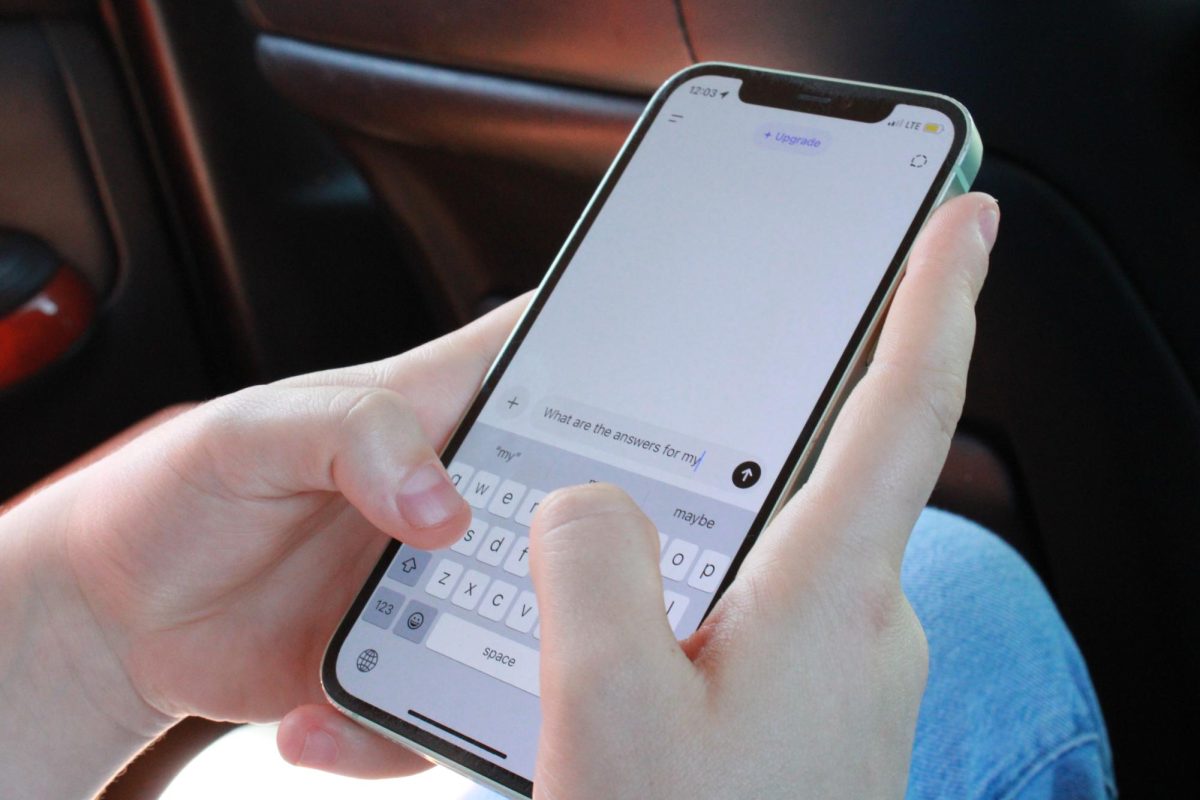
Whether it’s used for schoolwork, quick research or even casual conversations, artificial intelligence is an everyday reality for many students. AI sparks strong and often conflicting opinions among students, with responses ranging from excitement to fear. While some see it as a valuable tool, others describe it as deeply unsettling, with the potential to reshape education, creativity and even the future of humanity.
For junior Alan Yang, the thought of AI brings dread rather than optimism. Having read about the rapid development of superintelligent systems, he fears the consequences of technology advancing faster than humans can control.
“I think of extinction because I think of AI as a threat,” Yang said. “I do not trust AI falling into the hands of any bad person.”
Senior Trump Xie expressed skepticism from a different angle, focusing on the quality of AI outputs and their effect on jobs. While Xie acknowledged that AI could be useful in scientific or medical fields, he worries about its impact on the workforce.
“It is a threat to entry-level jobs, as more and more people will become less skilled and rely on a text-generating machine,” Xie said.
Not all students share the same pessimistic view about AI. Junior Jocelyn Zhang described her attitude toward AI as generally positive.
“It’s a good tool to help people learn,” Zhang said. “If I don’t know how to do something, I ask it.”
Similarly, though Yang warned that misuse could happen quickly and catastrophically, he admits AI has made his daily life easier.
“I use it mostly for homework, but I enjoy using it for leisure in my free time – debating political opinions,” Yang said. “It has sped up the process for me to research for debate, and it helps me with answering questions I do not know.”
As such, the role of AI in classrooms remains one of the most controversial topics today. Some students argue that it should play as small a role as possible, emphasizing that the information is often incorrect, which leads to the spread of false information and jeopardizes the truth.
“I think there should be no AI in education due to the false information that it provides,” Yang said.
Others are more open to its integration, especially as a supplementary tool in technical subjects. The tension lies between convenience and authenticity: while AI can accelerate research and problem-solving, it risks diminishing the need for critical thinking and originality.
“ChatGPT is good for academic purposes, [but] bad for artists,” junior Seaena Kim said.
Kim added that while AI can be a helpful learning tool in STEM subjects, it poses a risk to creativity and originality. Especially with the rise of AI image generators, such as ChatGPT and Sora, the demand for human-created art has continually decreased.
“[It will] replace jobs, and replace people’s creativity,” Kim said.
When asked about the future, many students predicted that AI will reshape the job market, often in negative ways.
“It will make applying to entry-level jobs more difficult since more and more people are using AI to apply for jobs and review candidates,” Yang said. “More people will lose their skills as they continue to use AI.”
Currently, AI can handle most, if not all, entry-level jobs, ranging from writing code to cashier roles to customer service. Employers can directly plug in prompts to AI to perform simple tasks, such as generating basic code or creating images. Furthermore, cashier jobs have already been replaced by AI in certain countries, eliminating the need for low-level positions, and AI chatbots are being used on a vast number of websites. Freelance jobs, such as those of artists or writers, would suffer the greatest impact, as books and images could be generated almost instantly, compared to the months it would take humans to complete them.
Together, these perspectives show how students are wrestling with AI. For some, it is a convenient assistant that makes homework and research easier; for others, it is a dangerous force that could take over jobs, creativity and end the world. Most students, however, recognize both sides: AI is powerful and useful, but it comes with risks that we have yet to fully understand.